AI for Learning & Assessment
Responsible AI integration for learning design, staff development, accessibility and professional workflow at UCL STEaPP.
I work with and advise on AI adoption across the major model families - platform-aware guidance with Microsoft Copilot as the primary UCL deployment.
 Copilot
 Copilot Studio
 ChatGPT
 Gemini
 Claude
 DeepSeek
Microsoft Copilot Rollout at UCL
Staff adoption and capability-building for the M365 Copilot licence rollout
The Problem
When UCL rolled out Microsoft Copilot M365 licences to staff, access alone did not translate into confident or effective use. Staff had the tool available but lacked structured support to engage with it meaningfully - and uncertainty about responsible use, data privacy and what the tool was actually for meant uptake was inconsistent across departments.
The Solution
Two parallel resources were developed: the AI Efficiency & Ethics Workshop (a participatory, practical session delivered six times across UCL - detailed below) and a standalone Copilot Guide infographic, designed to make the offering legible to staff who had never engaged with an AI tool before. The guide explains what Copilot is, where to access it, what it can be used for, and what responsible use looks like - without overwhelming staff with feature lists or technical jargon.
Outcome
The workshop series grew to six institutional deliveries and has been re-invited for further sessions into 2026. The Copilot Guide became a standalone staff resource, distributed alongside workshop delivery and embedded in onboarding materials for new staff. Attendees consistently reported moving from uncertainty about the tool to practical confidence in applying it to their own workflows.
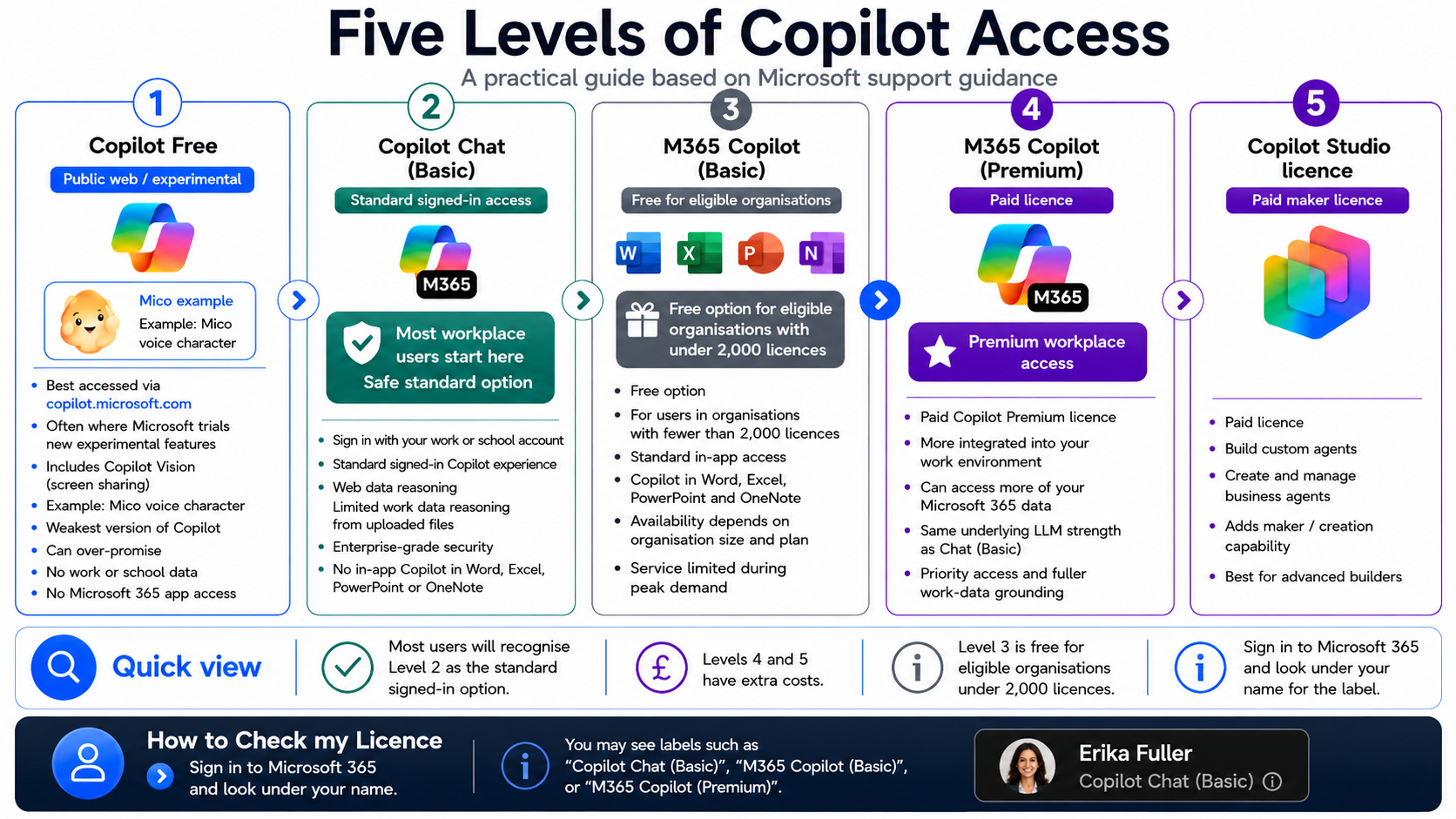
Staff-facing Copilot guide - developed to accompany the M365 rollout and provide a clear, accessible introduction to the tool and its responsible use.
UCL AI Accessibility Agent
AI-powered alt text generation for Moodle - deployed 2025
The Problem
As across many large digital learning environments, image descriptions in Moodle course materials were inconsistent and difficult to improve at scale - creating barriers for disabled learners and a compliance risk under the Public Sector Bodies Accessibility Regulations. Manual retrospective auditing was resource-intensive and did not address the problem at the point of authoring.
The Solution
Built using the standard Microsoft 365 Copilot agent experience on a standard licence - approved by the UCL Digital Accessibility team and shared organisation-wide across UCL. The agent improves accessibility at the point of authoring, not retrospectively.
Outcome
Live AI accessibility agent deployed at UCL STEaPP. Staff guidance materials and a responsible AI use framework published. The workflow supports improved accessibility practice by helping staff produce reviewable first-draft alt text at the point of authoring, reducing the friction of starting from nothing while keeping human judgement in the loop.
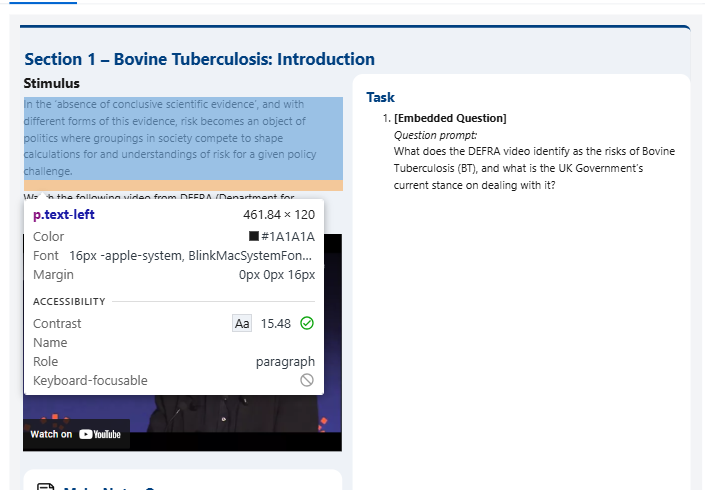
WCAG AA contrast testing during Moodle development - accessibility is built in, not audited afterwards.
AI Efficiency & Ethics Workshop
Delivered 6× across UCL, January 2025–present
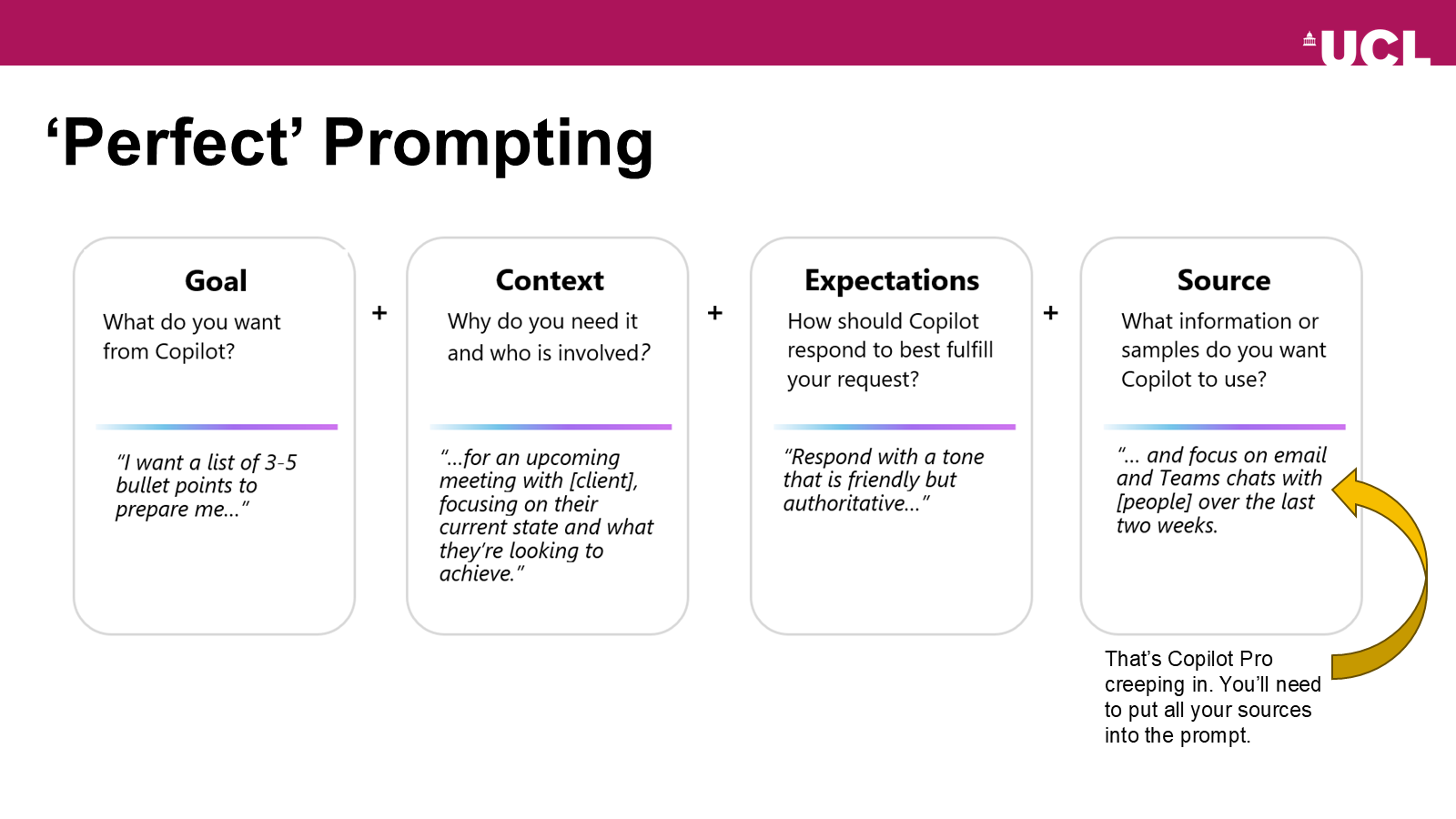
A practical workshop for academic and professional staff on reducing workload with AI tools - moving from passive curiosity to confident, responsible use. Covers what Copilot is and how it differs from other AI tools; practical demonstrations across three use-case scenarios; a prompting framework (Goal + Context + Expectations + Source); responsible AI and data privacy; and a Q&A close.
Delivery record at UCL (January 2025 – present):
- January 2025 - UCL STEaPP Department, initial delivery
- UCL STEaPP Faculty - extended to faculty-wide audience
- UCL Teaching and Learning Forum - institution-wide forum
- UCL Teaching Administrators Conference - professional services staff
- UCL Department of Primary Care & Population Health Away Day - invited keynote
- UCL Teaching Administrators Conference - re-invited for second delivery
Further deliveries scheduled - series remains active.
Available for delivery to teams and organisations.
AI Learning Guidelines for Students
Created with UCL STEaPP, Digital Education and Digital Accessibility Teams
As part of supporting the STEaPP Online MSc, I co-created an interactive resource providing practical guidance for students on how to use AI effectively and responsibly in their online learning. The resource was developed collaboratively with the STEaPP team, the UCL Digital Education team and the UCL Digital Accessibility team, and was digitised into Moodle as part of the onboarding materials for new online learners.
The guide covers what AI tools are available, how to use them responsibly in an academic context, the limits of AI-generated content, and how to apply AI to support - rather than substitute - independent learning. It reflects the principle that AI guidance for students should be practical, honest and grounded in the specific context of their programme, not a generic disclaimer.
The original interactive H5P version is embedded below:
Interactive H5P resource - Guidelines for Using AI for Effective Online Learning. Created in collaboration with UCL STEaPP, UCL Digital Education and UCL Digital Accessibility teams. Hosted on Moodle for STEaPP Online MSc students.
AI-Enhanced Moodle Learning Design
AI has been used to help design, structure and improve online learning materials across policy, science communication, risk and governance modules - always combined with sound learning design rather than as a standalone novelty. Assessment integrity in an AI context is a central design challenge, addressed through situational tasks, peer review, and reflective submissions.
See Digital Education for the full STEaPP Online MSc context, and Legal Compliance for the WCAG/accessibility regulations background.
Sector Engagement
UCL AI Champions Network
I am a member of UCL's AI Champions Network - a cross-institutional network of staff supporting responsible AI adoption across UCL. The network brings together practitioners from across departments and faculties to share emerging practice, provide peer support for staff exploring AI tools, and contribute to UCL's institutional approach to AI in education and research.
ALT Digital Assessment Special Interest Group - AI for Summative Assessment Sub-Group
I am a contributor to the AI for Summative Assessment Sub-Group of the ALT Digital Assessment Special Interest Group, formed in March 2025. The sub-group brings together practitioners and researchers examining AI in marking, feedback and moderation, with a strong human-in-the-loop position. My contribution has focused on supporting distribution of the group's large-scale (n=1,000) staff and student survey on AI in summative assessment, and helping disseminate its findings to the wider learning technology community.
UCL AI Champions Network - a cross-institutional community supporting responsible AI adoption.
Peer Support & Communities of Practice
I am an active contributor to UCL's internal communities of practice around the Power Platform and Copilot, providing hands-on peer support to colleagues across departments on automation, agent development and digital workflow. Recent examples include helping a Learning Technologist colleague at UCL School of Management debug HTML email template rendering in Power Automate - advising on email-client constraints such as Outlook and Gmail stripping inline styles, and the need for table-based layouts to achieve consistent rendering across clients. I have also supported colleagues troubleshooting Copilot agent distribution through Teams, drawing on my own experience navigating the distinct layers involved: the agent itself, publication channels, tenant-level approval, user permissions, authentication, knowledge sources and licensing. This peer support work is ongoing across UCL, and reflects a broader commitment to building institutional capacity rather than keeping technical knowledge siloed in a single role. I am awaiting permission to name the collaborators on this project.
 Copilot Studio - Support and Governance
I also support colleagues and student project teams with the less visible parts of AI agent development: environment strategy, publishing routes, authentication, guest access, licensing, ownership and handover.
A recent example involved a UCL student project team building a Copilot Studio agent for an external partner organisation. The agent had started in the default Power Platform environment, which was fine for early prototyping but not ideal for governance, external testing or eventual ownership. I tested a safer route using a simple agent first: exporting the agent through a Power Platform solution, importing it into a dedicated sandbox environment, enabling Dataverse, and investigating what external guest users could and could not access. The key finding was that migrating an agent into a dedicated environment improves governance, but does not automatically give external guests editing access in Copilot Studio.
For rapid prototype testing, I identified a workable route using a published Demo Website with no authentication. This allows external stakeholders to test the agent and provide feedback, but it has to be treated carefully: the site is unlisted, not private, so anyone with the link can access the prototype. This work helped separate three different needs that are often confused: internal development, external testing and final ownership.

The tested route separated prototype development, governed environment management and external user testing.
Read the Copilot Studio case studyAI in Workflow Automation
AI-Powered Lead Triage in Power Automate (IKON Training, 2023–24)
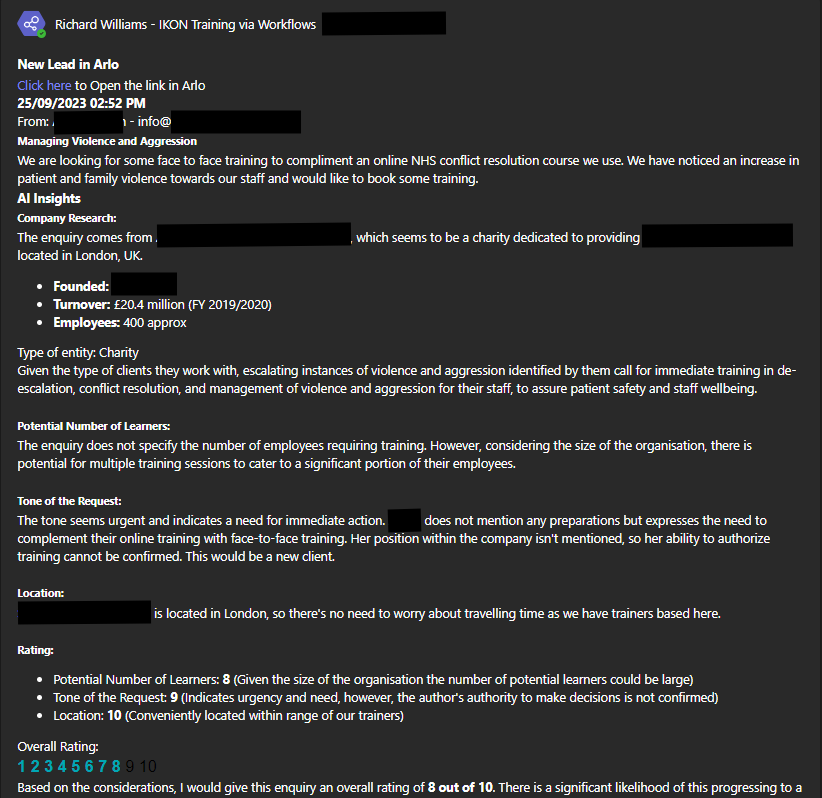
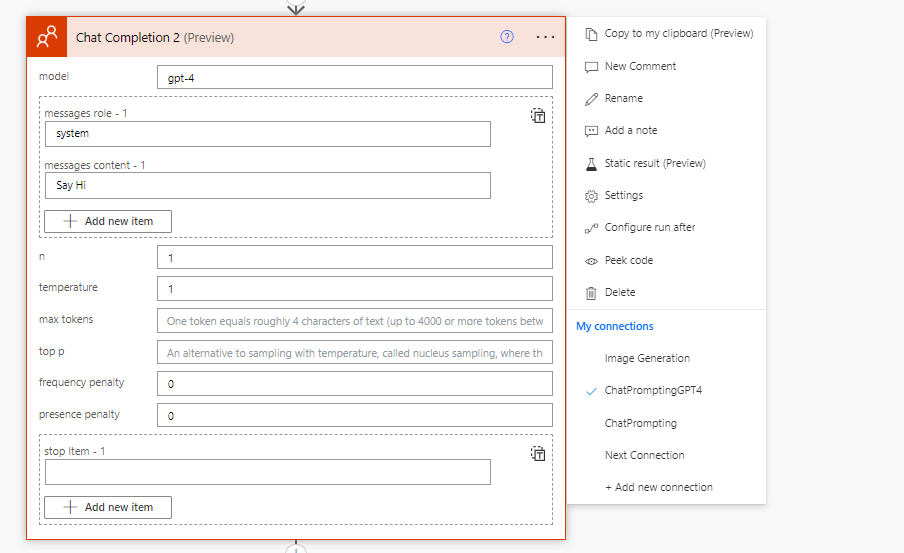
Built at IKON Training during a period when integrating LLMs directly into Power Automate was genuinely novel - before AI connectors became standard in enterprise platforms. An automated triage system scores incoming enquiries out of 10, prepending key variables (location, course relevance, tone) and conducting background research on the company to prioritise high-potential leads. Significantly reduced manual evaluation time.
LLM Integration for Communication Workflows
LLM integration also used to generate email template variations at scale - reducing routine content production time and freeing capacity for higher-value tasks. AI image generation was evaluated and deliberately discontinued on sustainability grounds, reflecting a broader commitment to responsible AI use - not just capability, but consequences.
AI Lead Scoring in Teams
GPT Integration in Power Automate
Key Outputs
- Live AI accessibility agent at UCL STEaPP (M365 Copilot, 2025)
- Staff guidance on responsible AI use
- AI Efficiency & Ethics workshop - 6 deliveries, re-invited
- AI guidance for students on acceptable and reflective use - including an interactive H5P resource co-created with the UCL Digital Education and Digital Accessibility teams
- Moodle learning activities designed with AI assistance
- AI-powered lead triage in Power Automate (live, IKON 2023–24)
- Prompt frameworks and workshop materials
- Assessment redesign guidance for AI contexts