Digital Education
Designing scalable, asynchronous, globally distributed postgraduate learning programmes - grounded in evidence, built for accessibility and equity.

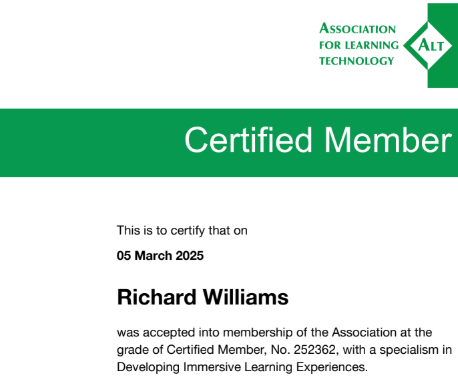
CMALT Certified Member
I am a Certified Member of the Association for Learning Technology (CMALT) - certified March 2025, Member No. 252362, specialism in Developing Immersive Learning Experiences. CMALT is the professional certification for learning technology practitioners, assessed by peer review against the ALT CMALT Framework. The six sections of my CMALT portfolio are preserved on the CMALT Portfolio page - the pages submitted for assessment and passed.
 Moodle
 H5P
H5P
 Power BI
 Dataverse
 SurveyMonkey
 Panopto
UCL STEaPP Online MSc
The STEaPP Online MSc is UCL's fully online, globally distributed postgraduate programme in Science, Technology, Engineering and Public Policy. Launched September 2025 - asynchronous, Moodle-delivered, designed for working professionals across time zones with no synchronous attendance requirement. The programme targeted 20 learners and enrolled almost 40. No withdrawals were recorded in the first monitored cohort (2025–26) - a significant outcome for a fully asynchronous online MSc.
My role: structural and pedagogical transition - working closely with academic staff to move 12 modules from face-to-face and blended formats into fully asynchronous online delivery. Every module was built to WCAG 2.2 AA: colour contrast checking, semantic HTML, meaningful alt text, captions on all video content, and clear language throughout. I produced interactive video learning content with iSpring for the STEaPP Policy Research Unit, used as learning content on the Online MSc. When UCL replaced Echo360 with Panopto as its lecture capture platform, I migrated existing lecture content between the two systems.

Illustrative UCL Moodle module page - card-based layout, structured weekly format and completion tracking applied across the STEaPP Online MSc.
Orchestrating Engagement
An Inclusive Model for High-Growth Online Policy Education
A research paper and conference poster co-authored with Dr Maria Cross (Lecturer and Professional Education Coordinator, UCL STEaPP). Presented at the CODE / RIDE Annual Conference, University of London, March 2026. The model centres on a weekly Stimulus → Process → Response cycle with a templated weekly format that supports learner orientation and reduces cognitive load.
100%
understood content purpose96.7%
agreed format was suitable90.9%
found examples diverse and relevant44%
spent longer on tasks than estimatedThe finding that 44% spent longer than estimated was treated as a problem with the time estimates, not the learners. Time estimates across all modules were reviewed and increased, with AI-powered reading time tools used for reading-based tasks. This was particularly important for neurodivergent learners. The model draws on Universal Design for Learning, Community of Inquiry, Cognitive Load Theory, and Constructivism.
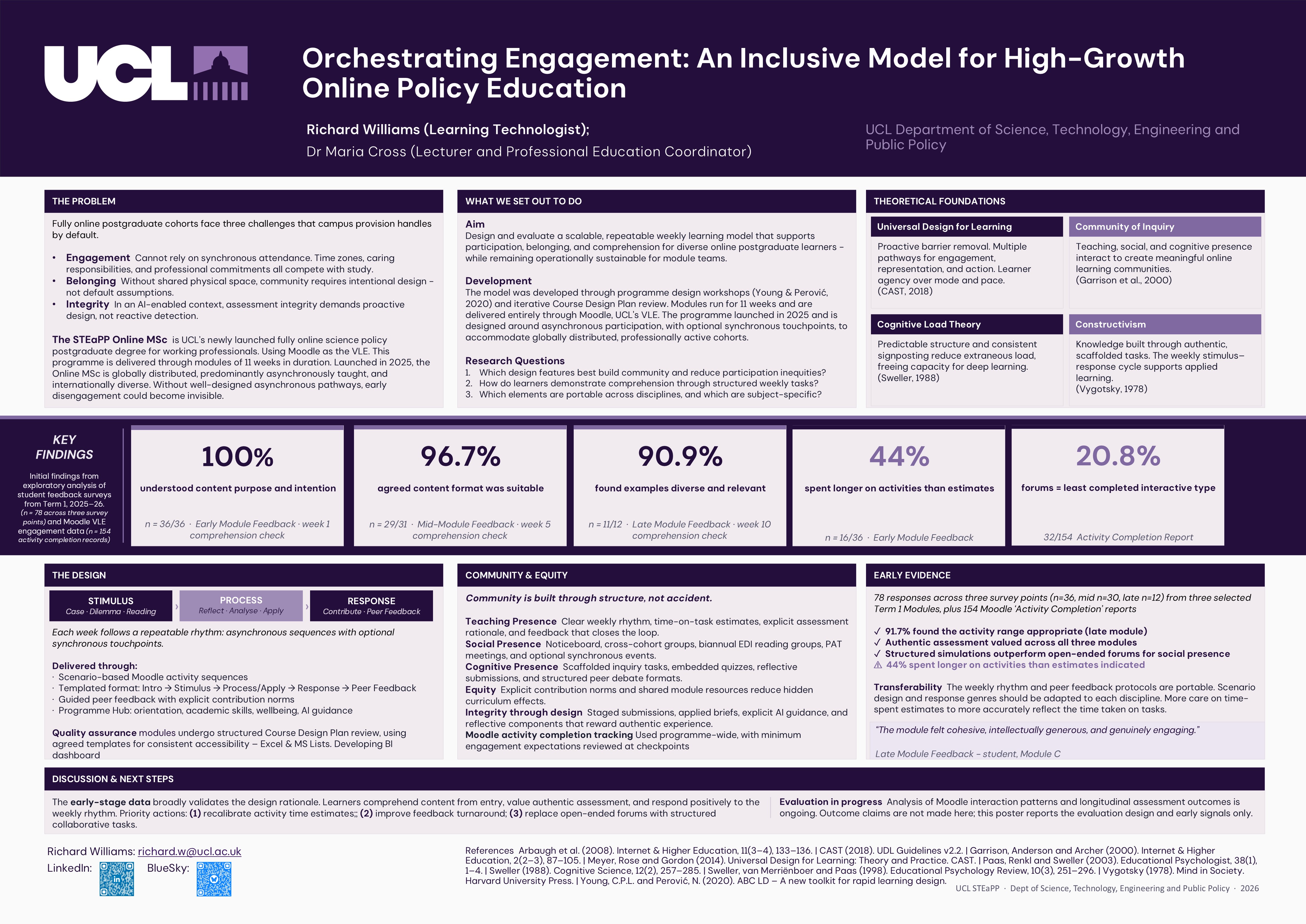
Conference poster - CODE / RIDE Annual Conference, University of London, March 2026.
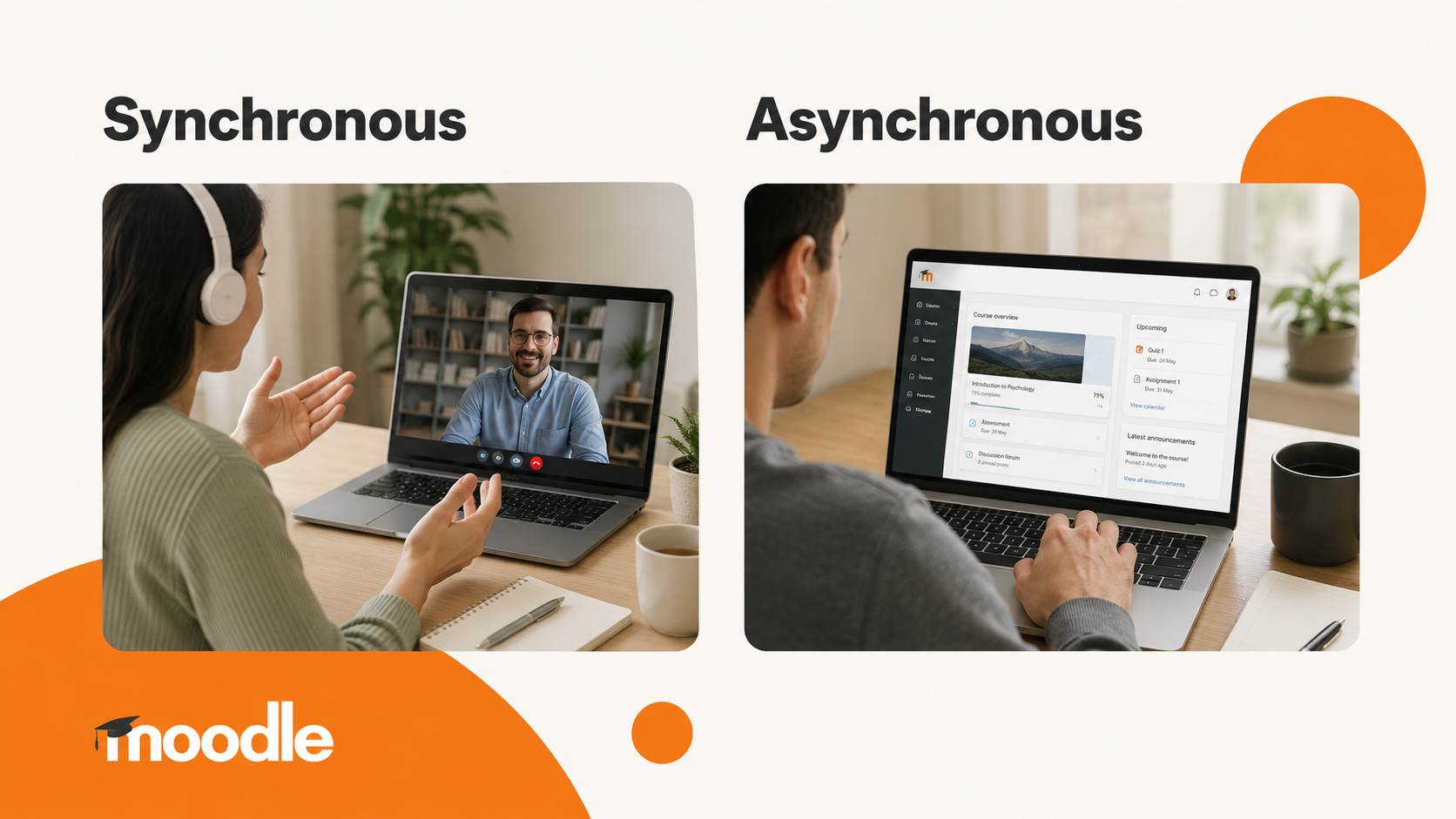
The Online MSc is fully asynchronous - no synchronous attendance requirement.
Immersive Scenario-Based Learning
Proof of Concept - IKON Training (2022–24)
At IKON Training I built a proof-of-concept branching, decision-based H5P activity placed directly within the IKON Academy Moodle platform - a Lone Worker safety scenario asking learners to make a series of safety-critical decisions with feedback at each stage. Built using H5P's branching scenario format, embedded directly into Moodle without external hosting or additional licensing.
The Lone Worker scenario demonstrates that interactive, immersive content was achievable within Moodle infrastructure without specialist authoring tools. For professional training in safety-critical or compliance contexts, scenario-based learning has a significant advantage over reading or video: it asks learners to apply judgement rather than absorb information.
Lone Worker - H5P branching scenario proof of concept at IKON Training.
Online Programme Design Principles
- Consistency over novelty - a repeated weekly structure reduces orientation time
- Asynchronous community - structured peer interaction and authentic forum prompts replace synchronous discussion
- Accessible by design - WCAG-compliant course pages, alt text, captions, plain-language instructions
- Assessment integrity - tasks designed to be situational, reflective and context-specific, and designed alongside Turnitin-supported submission workflows
- Evaluation built in - Moodle completion tracking, survey checkpoints, and the STEaPP Engagement Tracker
Related work
The engagement monitoring infrastructure is documented in the UCL STEaPP Moodle Engagement Tracker page. The AI tools and workshops are documented on the AI for Learning & Assessment page.