UCL STEaPP Module Development

Translating complex academic content - science policy, research funding and science communication - into structured, accessible Moodle-based online learning activities for postgraduate students.
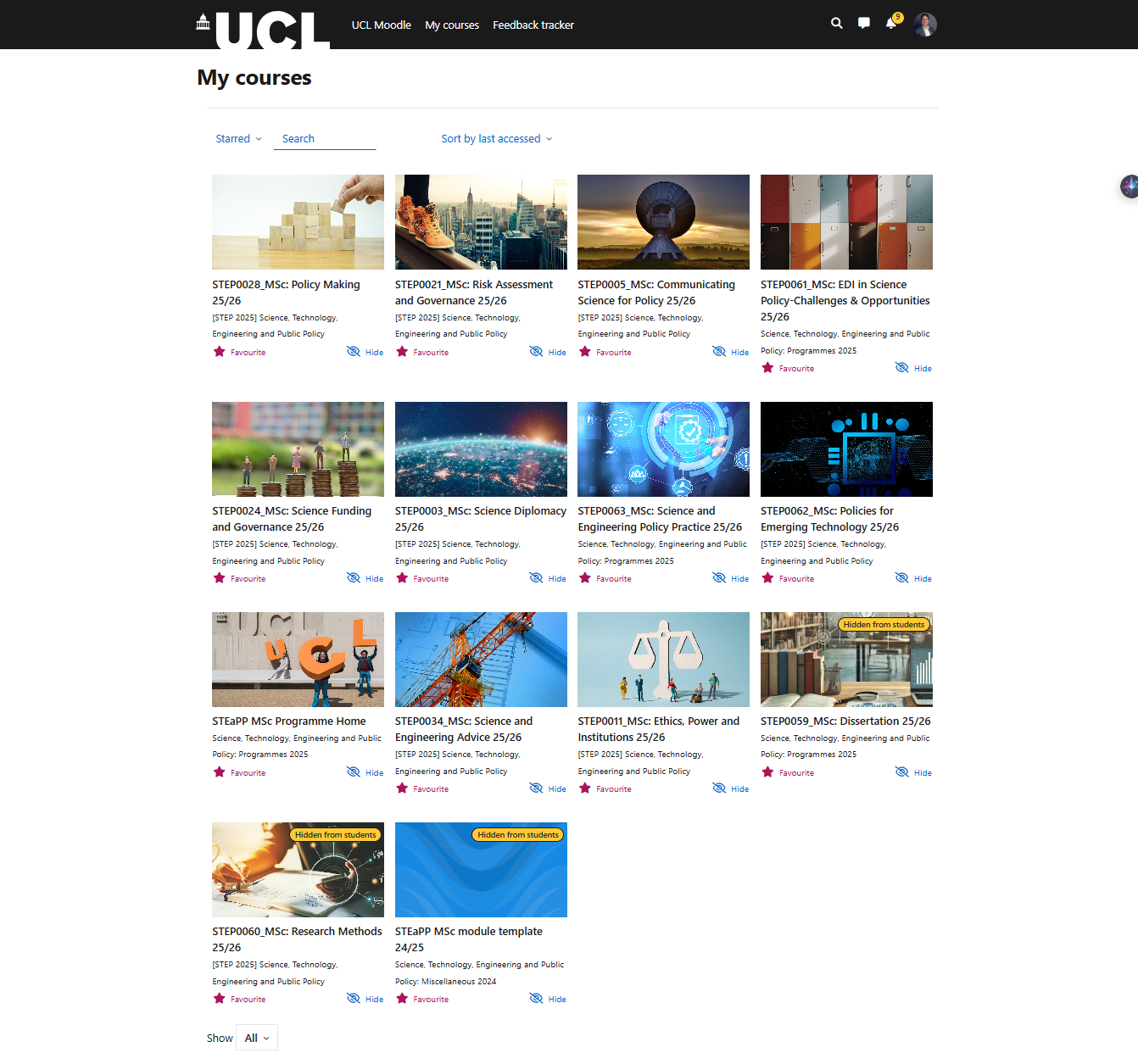
UCL Moodle My Courses page showing STEaPP Online MSc module cards - the programme context for the module development work

Moodle · Moodle Books · Forums · Databases · Panopto · Mentimeter · Padlet · HTML/CSS · Policy Education · Science Communication · UCL STEaPP

2025–2026 Module development period at UCL STEaPP
Online MSc Fully asynchronous, globally distributed postgraduate programme
STEP0024 Science Funding and Governance - one of several modules developed
Policy + Sci Comm Subject areas covered: research policy, science communication, contested science

1. Project Context

This case study covers my module development work at UCL STEaPP as part of the transition to a fully online, asynchronous postgraduate MSc programme. The work involved converting academic teaching plans, readings, videos, assessment ideas and discussion prompts into clear, structured, accessible Moodle-based activities for postgraduate students studying across different time zones and professional contexts.

The broader programme context is described on the UCL STEaPP Online MSc page. This case study focuses on two specific module areas: STEP0024 Science Funding and Governance and the Communicating Science for Policy strand - as representative examples of the module development approach.

Both modules involve complex academic material. The subject matter - science policy, research funding rationale, contested science, misinformation and public trust - does not naturally decompose into simple learning activities. A significant part of the design challenge was making the complexity manageable for students studying independently, without the support of a lecturer or seminar group present.

2. Problem and Need

Academic teaching plans often contain excellent ideas, readings, videos and discussion prompts - but in a format that assumes a lecture or seminar will provide the framing, context and structure that students need. In a fully asynchronous online programme, all of that framing needs to be built into the Moodle activity itself.

Students studying online, without a cohort visible in the same room, need:

  • Clear instructions for each activity - what to do, why it matters, what to produce
  • Context for each reading or video before they engage with it
  • Guided note-taking prompts to prepare for peer contributions
  • Explicit guidance on how to contribute usefully to peer discussions or databases
  • Transitions between activities that maintain coherence across a weekly learning sequence
  • Activities that work at different times, in different time zones, without requiring synchronous contact

The specific design challenge for these modules was also one of subject complexity. Topics like the economic rationale for research funding, contested scientific evidence, or science communication in political contexts require students to engage critically with contested ideas - not just absorb factual content. The activities needed to be designed to prompt analysis, comparison and reflection, not just comprehension.

An additional challenge: variety of activity types

A single weekly topic in these modules might require: a reading or video, a structured note-taking activity, a group discussion Forum, a Database submission, peer feedback, and an individual reflection. Designing that sequence coherently - so each activity builds on the last and prepares students for the next - requires careful instructional sequencing, not just content placement.

3. My Role

My role was to act as the learning design and Moodle implementation lead, working with academic staff and programme teams to convert module plans into structured, accessible, student-facing Moodle activities. This involved:

  • Translating academic module plans into Moodle activity sequences
  • Building Moodle Books, Pages, Forums, Database activities and quizzes
  • Writing and refining student-facing instructions and activity guidance
  • Structuring reading, watching, reflection, note-taking and peer interaction
  • Applying accessible HTML formatting and consistent visual layout
  • Creating reusable patterns for repeated module development
  • Supporting academic colleagues with digital learning design decisions
  • Checking and improving accessibility across all content elements

4. Tools and Platforms

Moodle LMS (UCL instance) Moodle Books Moodle Pages Moodle Forums Moodle Databases Moodle Quizzes Panopto (video) Mentimeter Padlet Mahara (e-portfolio) HTML/CSS within Moodle editor Accessibility checking Microsoft 365 (planning and content drafting)

5a. What Was Built: STEP0024 Science Communication

STEP0024 is the module where my contribution was most substantial. In addition to designing and building the Moodle activity structure, I filmed a series of weekly videos and a set of expert interviews for the module, and oversaw the creation of content from start to go-live through weekly working meetings with the two subject matter experts (SMEs). This went significantly beyond translating existing material into Moodle - it involved originating content, co-producing media, and providing ongoing pedagogical guidance throughout the development process.

My contribution to STEP0024
  • Video production: filmed a series of weekly introduction and context videos for the module, providing students with a guided entry point to each topic before engaging with readings and activities
  • Interview series: filmed and produced a series of expert interviews for use in the module as primary learning resources
  • Content oversight: worked with two subject matter experts through a full module development cycle, from initial planning through to reviewed, published content
  • Weekly SME meetings: facilitated and led weekly working sessions with the two SMEs to help them structure and develop their academic content for online delivery
  • Moodle design and build: translated the developed content into structured Moodle Books, Pages, Forums, Databases and activity sequences using the design system
  • Pedagogical guidance: advised on activity design, sequencing, student instructions and the balance between content delivery and active learning
Topics covered in the module
  • Economic rationale for funding research and development
  • Science and research as a public good
  • Priorities for research funding
  • Political rationale for funding R&D
  • Priorities for funding business innovation
  • Transformative change and strategic research investment
  • Budget allocation and priority-setting
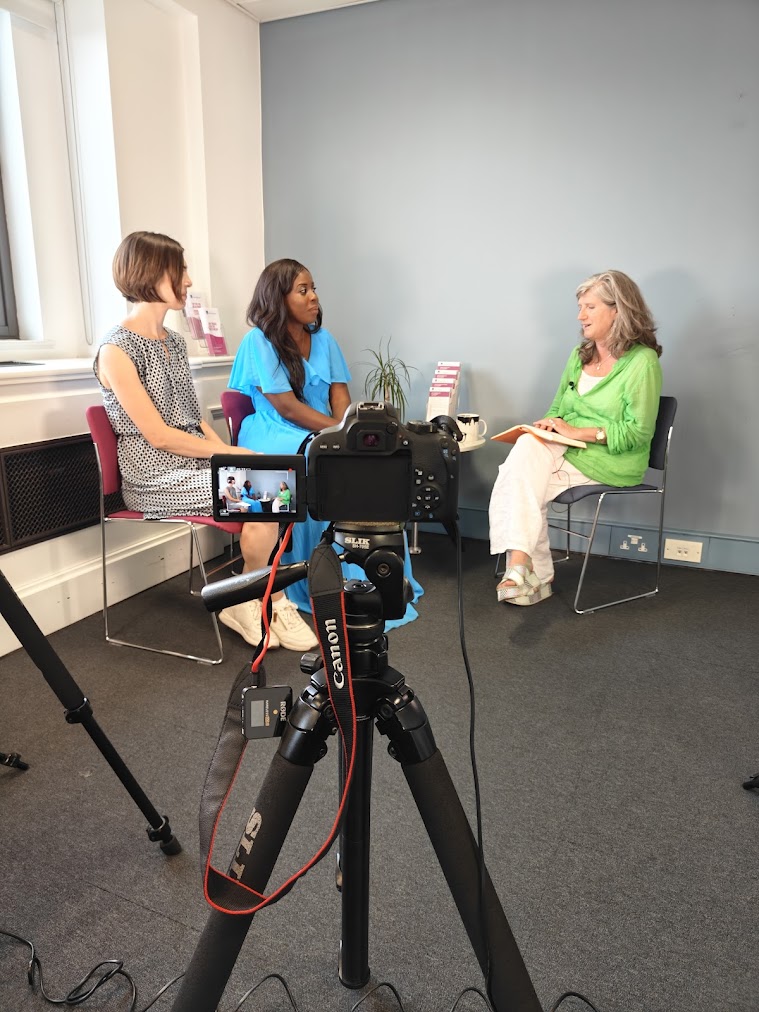
Video and media production work at UCL STEaPP - filming content for the STEP0024 Science Communication module, including weekly introductions and expert interview series

Media production for STEP0024 - filming weekly context videos and an expert interview series for the module.

Activity sequence example: Budget Allocation Simulation

One of the stronger sequences in STEP0024 was a budget allocation exercise: contextual reading → Make Notes → group planning Forum → group Database upload → peer feedback → individual reflection Forum. This is a core pattern in the design system, effective for contested or values-laden topics where student position may shift through the activity arc.
Evidence to add: Screenshots of STEP0024 Moodle pages, Book chapters or forum instructions when available.

5b. What Was Built: Communicating Science for Policy

The science communication strand covers how scientific evidence is communicated to policy audiences - including contested science, misinformation, public trust and the relationship between science, media and political decision-making. This is material that requires students to analyse, evaluate and reflect on communication strategies and the social dimensions of scientific knowledge.

The design challenge here was to avoid presenting complex, contested material as flat readings or lectures. The activities needed to give students frameworks for thinking critically about science communication - and to connect those frameworks to real examples before asking students to contribute their own analysis.

Topics and content areas developed
  • Communicating contested science - misinformation, mistrust and complexity
  • Science communication to governments and legislatures
  • Technical, social and political dimensions of communicating science to policy audiences
  • Merchants of Doubt - the use of uncertainty and doubt as a communication strategy
  • Social media and contested science
  • Climate change, national security and policy inquiry evidence
  • Vaccine confidence, public trust in science, and media
Design approach for contested topics

Activities in this strand were designed to prompt analysis, not just comprehension. Students were asked to:

  • Identify the communication strategies being used in real examples
  • Consider the audiences and contexts being addressed
  • Compare different framings of the same scientific issue
  • Reflect on how their own assumptions or prior knowledge shaped their reading
  • Contribute their analysis to structured peer discussion
Activity formats used
  • Moodle Books exploring conceptual frameworks in manageable chapters
  • Accordions for complex multi-part concepts - reducing visual density
  • Reading and note-taking prompts before analysis tasks
  • Structured forum tasks with specific contribution guidance
  • Database submissions for peer contribution and review
  • Quizzes for knowledge checks on specific examples or terminology
  • Embedded Panopto video with note-taking prompts
  • Mentimeter or Padlet activities where synchronous or visual engagement was used
  • Reflective transitions connecting complex topics

Evidence needed: Screenshots of science communication activity pages, forum instructions, or database tasks. Examples of structured discussion prompts on contested science topics. Please provide when available.

6. Stakeholders

Module Academic Leads

Provided the academic content and taught intentions - my role was to translate these into workable Moodle activities.

Programme Teams

Responsible for overall programme coherence, student support and quality - needed a consistent, manageable module structure.

STEaPP Online MSc Students

Postgraduate learners studying asynchronously across time zones - the primary audience for the activities.

Digital Education Team

Colleagues supporting Moodle and online provision more broadly.

7. Evidence and Artefacts

  • Moodle Book chapters from STEP0024 - structure, learning outcomes and embedded activities
  • Forum task instructions - consistent structured format
  • Database contribution and peer feedback activity pages
  • Examples of the budget allocation simulation sequence
  • Science communication activity pages - contested science topics with structured analysis prompts
  • Before/after comparison: raw academic plan versus structured Moodle activity
  • Student feedback data from the first cohort (2025–26) - reported in the Orchestrating Engagement conference paper

Screenshots to be added. Please provide examples from STEP0024 and the Science Communication strand - particularly the budget allocation simulation sequence, any forum activity instructions and any before/after examples of academic content becoming structured Moodle activities.

8. Outcome and Impact

Student feedback from the first cohort of the STEaPP Online MSc (2025–26) indicated strong engagement with the structured module format. Reported in the co-authored conference paper presented at CODE/RIDE (March 2026), key feedback data included: 100% of respondents understood content purpose and intention; 96.7% agreed the content format was suitable; 90.9% found examples diverse and relevant.

These figures relate to the programme as a whole rather than to individual modules. They are presented here as indicative evidence of the effectiveness of the design approach, drawn from 36 student responses across three selected modules in Term 1 of 2025–26.

The work demonstrated that complex academic content - including contested science, policy analysis and research funding debates - can be made manageable for independent online study through careful instructional design, without simplifying the material or reducing the intellectual demands placed on students.

9. Reflection and Learning

The most challenging part of this work was not the technical side - building a Moodle Book or a Database activity is not difficult in isolation. The challenge was making the academic content work as online learning. This means asking: what does a student need to know before they can engage with this material meaningfully? What note-taking or reflection step will help them form a view before they contribute publicly? What kind of peer contribution is genuinely useful, rather than formulaic?

Working with academic staff on these modules also reinforced the importance of translating between different ways of thinking about learning. A lecture can rely on the lecturer to provide framing, context and energy. An asynchronous Moodle activity needs to carry all of that itself - in written instructions, clear structure and a purposeful activity design that gives students a reason to engage beyond meeting a completion requirement.

The science communication strand was particularly useful for thinking about the relationship between complexity and accessibility. Some of the most academically rigorous material - contested evidence, conflicting studies, political dimensions of scientific knowledge - is also some of the most important for students to engage with critically. The design approach aimed to make complexity approachable without resolving it artificially.

Skills demonstrated

Online learning design Academic content transformation Moodle activity development Instructional sequencing Peer interaction design Asynchronous learning design Academic staff support Policy and science communication content